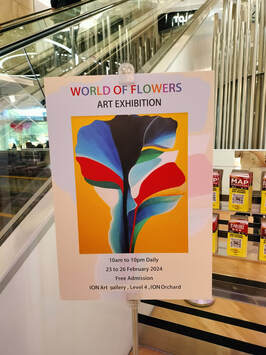
The question before a single work is chosen
A solo exhibition is, before anything else, a proposition. It asks whether a body of work has enough internal coherence to hold a room on its own. Group shows allow an artist to contribute one or two pieces and let the broader programme carry weight. A solo show removes that safety. Everything on the walls speaks for the same painter, so the first task is not choosing what to include but deciding what the show is actually about.
For a painter whose subject is consistently flowers, that question is still genuinely open. Which species, which palette register, which scale? JJ Tan's paintings move between lilies, orchids, hibiscus and forms that are less botanical than imagined. A show built entirely around one genus reads differently from a show that ranges across many. Neither is wrong, but the choice shapes everything that follows, from the number of works needed to how the room will feel when someone walks in.
Selecting works and reading them together
Once a painter has a working premise, the process of selecting works involves laying them out, either physically or in a plan, and reading them as a group rather than individually. A painting that holds up well in isolation may pull against its neighbours once hung. Colour temperature is one reason: a canvas dominated by deep reds and dense greens will absorb the light around it, while a painting with yellow petals on a dark ground throws that light forward. Placed carelessly, two strong canvases can fight each other and fatigue the eye before a visitor has moved very far along the wall.
The works that have come from JJ Tan's practice carry saturated colour, bold outlines and large petal forms that press toward the edges of the canvas. That insistence on filling the picture plane means each painting makes a strong claim on space. A selection of eight or ten such works needs room to breathe, and the painter has to be willing to set aside pieces that are individually strong but collectively too much.
Sequencing and the shape of a room
Hanging a show is not decoration. It is an argument made in space. The order in which a visitor encounters works, the pauses built in by an empty stretch of wall, the decision to place two closely related paintings together or to separate them, all of these affect how the work is understood. A painter who hangs their own show is effectively editing a text after the writing is done.
Gallery spaces impose their own logic. The exhibitions JJ Tan has shown in, including ION Art Gallery in Singapore, The Arts House, Gangshan Cultural Art Centre, YangMing Road Art Gallery and Howard Plaza Hotel Kaohsiung, each have different proportions, different wall heights and different relationships between natural and artificial light. A painting that looked definitive in the studio may look small in a double-height room, or overwhelming in a corridor. The painter learns this only by being in the space with the work.
There is also a practical sequence to installation itself. Works are typically positioned on the wall before fixings are made permanent. Heights are checked against eye level for a standing adult. Sightlines from the entrance are tested. In a show where several large canvases are involved, this can take longer than expected, and it requires a willingness to move a painting more than once until the placement is right.
What the room is asking the visitor to do
A well-hung exhibition guides attention without appearing to. The visitor feels that they are choosing where to look, but the arrangement is already making suggestions. A single strong painting at the far end of a room draws people through the space. A pair of works facing each other across a narrow gallery create a conversation that stops a visitor mid-step. These are not tricks. They are the painter's last act of direction before the work passes entirely to the person standing in front of it.
For painting in which colour is the primary language, the sequence in which a visitor encounters different palette registers matters considerably. Moving from cooler tones toward the deep reds and pinks that appear regularly in JJ Tan's work creates a different experience from the reverse. The painter has to think about this the way a musician thinks about the order of pieces in a programme, not arbitrarily, but with some intention about where the emotional weight falls.
After the last painting is hung
The preparation does not end when the works are on the wall. Titles, if used, need to be set. Any written material accompanying the show has to be consistent with what the paintings actually do, not with what the painter hoped they would do or what an early draft said they might. A statement that overclaims on behalf of the work undermines it.
What remains, once all of this is done, is something that could not have been predicted at the start: a room with its own character, made from individual canvases but no longer reducible to them. That is what a solo exhibition is, finally. Not a survey of paintings but a single constructed experience. The paintings in the Works archive give a partial sense of how JJ Tan's individual canvases look in isolation. A room of them, sequenced and hung, is a different thing entirely.