Across the strait
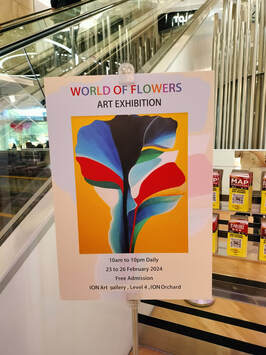
JJ Tan is a Singaporean painter whose work centres almost entirely on flowers. Lilies, orchids, hibiscus, and forms that sit somewhere between botanical record and imagined garden — these are his consistent subjects, rendered in acrylic on canvas with saturated colour and bold, defining outlines. The paintings are large in feeling even when they are not large in scale: petals press toward the edges, reds and pinks sit hard against deep greens, and yellow forms emerge from blue or near-black grounds as though the light source is inside the plant rather than above it.
For some years now his practice has been organised around two places: Singapore, where he was born and where his work has been exhibited, and Kaohsiung, in southern Taiwan, where he studied at Kao Yuan University. That division is not incidental. The two cities have asked different things of the work, and the paintings that have come out of that period reflect both.
Studying in Kaohsiung
Kao Yuan University sits in the Lujhu district of Kaohsiung, a city whose arts infrastructure includes municipal cultural centres and a long habit of supporting exhibiting artists alongside students. For a painter whose subject is flowers, the visual environment of southern Taiwan is not irrelevant: the humidity, the particular quality of light, the density of botanical life are part of what a painter registers even when working abstractly or from memory. Tan's time there was formal study, and the paintings that followed show a confidence with colour relationships and outline that sustained studio practice tends to build.
The work he made during and after that period has been shown at the Gangshan Cultural Art Centre and at Howard Plaza Hotel Kaohsiung, as well as at the YangMing Road Art Gallery. These are not marginal venues. Gangshan, in particular, is a district-level cultural institution with a programme that sits alongside municipal arts activity in greater Kaohsiung. Showing in these contexts placed the work in front of Taiwanese audiences who had no prior relationship with it, and that is a different kind of test than showing at home.
Exhibiting in Singapore
Back in Singapore, Tan has shown at ION Art Gallery and at The Arts House. ION Art Gallery occupies a position within ION Orchard that gives it both foot traffic and a degree of institutional standing; The Arts House, in the former Parliament building on Old Parliament Lane, has a programme that sits within Singapore's broader arts calendar. Neither venue is a commercial pop-up. The work shown in Singapore has reached audiences for whom Tan is a local painter — a Singaporean artist — rather than a foreign one, and that distinction changes how a painting is initially received even when the painting itself is unchanged.
The floral subjects travel well in one sense: flowers are not geographically specific in the way that landscapes or cityscapes are. A hibiscus painted in Kaohsiung does not announce its origin. But the paintings carry the decisions made during the period of their making, and those decisions were shaped by where Tan was working, what he was studying, and who he was showing work to.
Communication through painting
Tan is autistic. That fact is part of the biographical record and it is relevant in a specific, limited way: for him, painting became a direct means of communication at a stage when other means were less available to him. This is worth stating plainly because it explains the seriousness with which the work is made, and it places the choice of subject — flowers, repeated, closely observed, rendered with considerable intensity of colour — in a context that is neither decorative nor incidental. The paintings are not illustrations of feeling; they are the result of sustained attention to a subject that repays sustained attention.
None of that changes what the work looks like or how it functions as painting. Large petal forms fill the canvas. Colour is handled with confidence rather than caution. The outlines are deliberate. These are observable qualities, and they are what a viewer encounters first.
The work now
A practice built across two cities over several years produces a body of work that is larger and more varied than one built in a single place. The Kaohsiung exhibitions and the Singapore exhibitions are not separate catalogues; they are the same ongoing project, shown to different audiences at different points in its development. What that movement gave the work is harder to state as a single thing — it is in the colour decisions, the scale instincts, the repeated return to the same botanical subjects with slightly different results each time.
Tan continues to work between Singapore and Kaohsiung. The paintings remain what they have been: acrylic on canvas, flowers, saturated colour, bold outline. Explore the Works archive to see the floral studies together and follow how the subject has developed across the full body of work.