Why the tropical climate deserves attention
Collectors in Singapore and Taiwan live with conditions that are genuinely demanding for works on canvas. Ambient humidity routinely sits between 70 and 90 per cent, temperatures climb through the day, and air-conditioning creates rapid swings between warm moist air and cool dry air whenever a door opens. Acrylic paint film is relatively flexible compared with oil, and canvas itself is hygroscopic, meaning it absorbs and releases moisture. Over years, repeated expansion and contraction can stress the join between paint and ground.
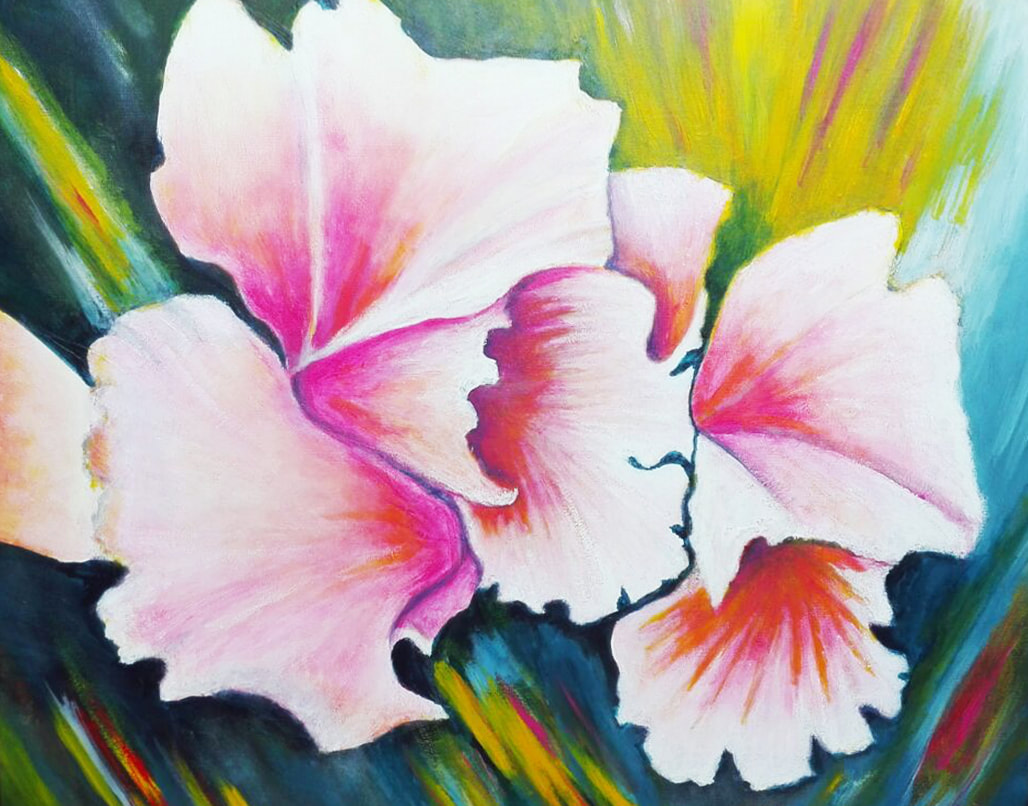
Understanding how to care for acrylic paintings in this climate is not a matter of anxiety but of straightforward habit. A painting that is well placed and occasionally checked will remain stable for decades. The notes below apply to any quality acrylic work on stretched canvas, including the flower paintings in this studio, whose saturated grounds and bold areas of flat and modulated colour place particular demands on surface stability.
Choosing where to hang the work
The single most protective decision a collector makes is where in the room the painting lives. Direct sunlight is the primary concern: even pigments described as lightfast will shift gradually under intense ultraviolet exposure, and the effect is irreversible. Position the canvas so that no direct beam of sunlight falls on it at any point during the day. Indirect natural light, or well-diffused artificial light, is entirely safe and is usually the most flattering way to see a painting in any case.
Avoid hanging directly above an air-conditioning unit or beside a vent. The cold dry air blown onto the canvas surface accelerates the very cycling of moisture that causes long-term stress. A wall that holds a relatively even temperature through the day is preferable to an exterior wall that heats significantly in afternoon sun. In older shophouse or apartment buildings in Singapore and Taiwan, a solid internal wall is often the best option.
Keep some clearance between the back of the canvas and the wall surface. A few centimetres of air gap allows air to circulate gently behind the stretcher, which discourages mould forming on the back of the canvas in humid months. Most commercial hanging hardware naturally provides this gap, but it is worth checking.
Light sources and UV exposure
Artificial lighting choices matter more than many collectors expect. Older halogen and incandescent fittings produce infrared heat that warms the canvas surface directly. LED sources are cooler and, provided they are specified as low-UV, are the practical standard for illuminating works at home. Specialist picture lights with an integrated low-UV LED strip are widely available and work well with vertically hung canvas paintings.
Museum-quality UV-filtering glazing is sometimes suggested for works on paper or watercolour, but acrylic and oil paintings on canvas are almost never glazed. The practical protection comes from controlling the source rather than filtering at the surface. If a room has large east- or west-facing windows that cannot be shaded effectively, UV-filtering window film applied to the glass is a proportionate and relatively inexpensive solution.
Humidity, air-conditioning and storage
A relative humidity somewhere in the range of 45 to 65 per cent is widely cited as the stable zone for paintings on canvas. In a Singapore or Kaohsiung apartment that figure is aspirational for much of the year, and the goal in practice is consistency rather than a perfect number. Avoid the extremes: a room that runs the air-conditioning at its coldest setting all day and then warms overnight to full ambient humidity is harder on a painting than a room that sits at 75 per cent but holds that level steadily.
If a painting needs to be stored rather than displayed, stand it vertically rather than flat, keep it away from floors where air circulation is lowest and moisture accumulates, and never lean multiple canvases face-to-face without protective interleaving. Acid-free glassine or clean cotton cloth between surfaces is sufficient. A climate-controlled storage facility is the correct solution for long-term storage of any significant work.
Cleaning and long-term maintenance
The surface of a cured acrylic painting is more robust than many collectors assume, but it attracts and holds dust because the paint film carries a slight static charge. In a tropical home, dust mixed with humidity can begin to adhere over time. The practical approach is light, regular dusting with a clean, dry, soft-bristled brush, working gently across the surface without pressure. Do not use compressed air canisters, which can drive particulates into any textural areas of the paint.
Avoid any liquid cleaner, damp cloth or household product on the painted surface without professional advice. Even plain water can disturb a surface that has any crazing or lifting, and solvents marketed as safe for plastics are not safe for paint films. If a painting accumulates grime beyond what dry dusting addresses, the correct step is to consult a conservator rather than to attempt cleaning at home. In Singapore the National Heritage Board maintains guidance on accredited conservation professionals. In Taiwan, Kaohsiung's cultural institutions offer similar referrals.
A painting that is hung thoughtfully, kept away from direct sun and stable moisture extremes, and dusted occasionally needs very little else. If you are considering adding a work to your home and would like to discuss the specific conditions of your space, you are welcome to get in touch through the contact page of this site.